

Chapter 2 – The 80-Year Institutional Cycle
America’s story moves in predictable waves. Every eighty years or so, the country tears down its old institutions and builds new ones.
The pattern goes like this:
- 1780s: Constitution is set after the revolution
- 1860s: Civil War and Reconstruction.
- 1940s: Great Depression and World War II.
- 2020s: Now- another reckoning.
Each cycle lasts roughly the span of a long human life, about four generations. The people who built the last system eventually die, and with them goes the memory of what broke it. The next generation inherits the institutions without understanding the sacrifices that made them viable and necessary, and slowly, those systems become rigid, self-protective, and brittle.
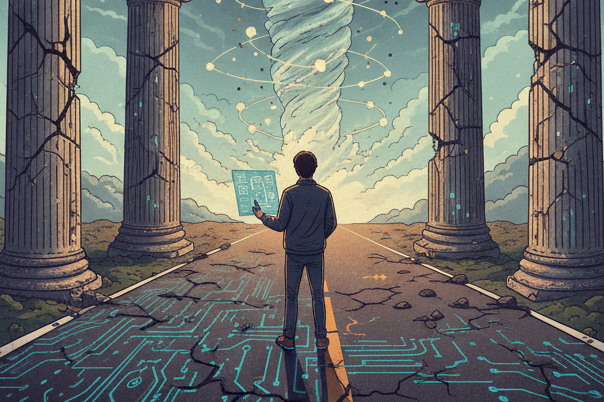
That brittleness is what you’re feeling right now—in politics, in media, in universities, and even in corporate life. These institutions aren’t failing because of bad people. They’re failing because they’ve reached the natural end of their design.
William Strauss and Neil Howe called this rhythm The Fourth Turning. George Friedman calls it The Calm Before the Storm. Both describe the same thing: a civic winter. It’s the period when trust collapses, old rules stop working, and society reboots itself.
This isn’t new. It’s what happened in 1776, in 1861, in 1939. The crises differ, but the pattern is identical. Every time, an old order gives way to a new one.
The 2020s mark the close of another eighty-year cycle. The post–World War II institutions that defined your grandparents’ and parents’ lives—NATO, the Federal Reserve’s dominance, legacy universities, global corporations—were built for an era of scarcity and hierarchy. They thrived on central control. But you were born into a networked world that doesn’t need permission or intermediaries. You can publish, transact, and collaborate across borders from a phone.
That shift—decentralized capability meeting centralized decay—is the defining tension of your era.
You are the first generation to grow up fully online, and the last one to remember a pre-AI world. You’ll inherit not just broken systems but the tools to rebuild them differently. Every previous Fourth Turning produced new systems of governance and belief. The next one will produce a new architecture of trust—more open, more local, and more algorithmic than anything before.
The chaos of the 2020s is the demolition phase. What follows is construction. The only question is who picks up the blueprints.
Section Notes
Theme: Explaining the repeating institutional life cycle and situating the reader in today’s “Fourth Turning.”
Sources & Influences: The Fourth Turning Is Here (Strauss & Howe), The Storm Before the Calm (Friedman).
Editing Intent: Could expand with a sidebar timeline or visual showing each 80-year cycle and its outcomes. Add a short generational quote at the opening for emotional entry.