

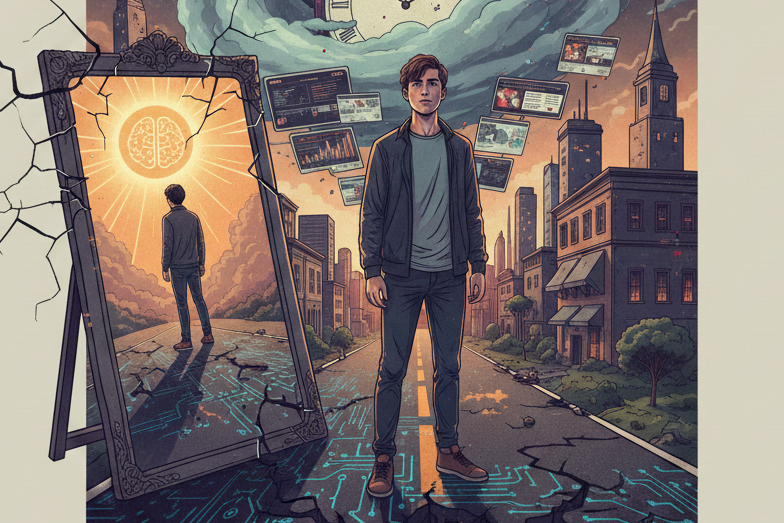
Chapter 3 – The 50-Year Technology Cycle
If the 80-year rhythm resets power, the 50-year rhythm rewires productivity.
Roughly every half-century, a breakthrough technology transforms how humans create, communicate, and trade.
- 1800s: Steam and railroads—distance collapsed.
- 1900s: Electricity and internal combustion—cities bloomed.
- 1970s: Microchips and software—the digital revolution.
- 2020s: Artificial intelligence and blockchain—the autonomy revolution.
Each wave starts with invention, then boom, saturation, and stagnation. The pattern is as reliable as the institutional cycle that runs beside it. When one ends, society strains to find the next source of growth.
We’re now at the hinge point between the microchip age and whatever comes next. The Internet and smartphones connected the world, but they also centralized it—massive companies controlling data, communication, and attention. That’s the paradox of the last 50 years: a networked world dominated by middlemen.
The next cycle is different. AI, cryptography, and autonomous systems dissolve middlemen. They don’t just connect us—they coordinate us, with code, virtual assistants, and robots replacing institutions as the mechanism of trust.
That’s what makes this technological moment so explosive. It doesn’t just promise new products; it rewrites incentives. In previous eras, innovation created scale. In this one, innovation creates independence.
Think about that: For the first time in history, individuals have access to tools—computational, creative, financial—that once belonged only to governments or corporations. With an open laptop, you can design, publish, trade, and broadcast to the world. The marginal cost of creation is approaching zero.
Yet the economic system built in the 20th century depends on scarcity. It needs limits, gatekeepers, and friction. So while technology keeps lowering costs, the system keeps inflating prices—a tension we’ll unpack soon.
Every prior technological revolution created both chaos and opportunity. Factories displaced artisans but birthed the middle class. The internet disrupted journalism but democratized expression. This one will do both on a larger scale.
You’re entering adulthood in the 2020s – the first time that the 80 year institutional cycle and the 50 year technology cycle have transitioned at the same time- just as the old engines of growth sputter and the new ones ignite. If you learn how these cycles move, you’ll stop fearing volatility and start using it. Because the next twenty years won’t belong to those who control resources. They’ll belong to those who control leverage.
“Leverage” means multiplying what one person can do — turning an hour of thought or creativity into something that scales infinitely. In the industrial age, leverage came from owning factories or oil fields. In the digital age, it comes from building automation that works while you sleep, building a networked audience or platform, starting a business way more cost efficient than a generation ago, and most importantly learning how to direct, shape, and extend AI to yield exponential productivity and creativity.
The opportunity is here for you to take. Your generation is best positioned. Start shaping your “leveraged” mindset today.
Section Notes
Theme: The rhythm of technological revolutions and the transition from the microchip era to the autonomy era.
Sources & Influences: Peter Zeihan (The End of the World Is Just the Beginning), Ray Dalio (Changing World Order).
Editing Intent: Add concrete mini stories—e.g., one factory example from the Industrial Age and one startup example from the digital era—to make the concept vivid.